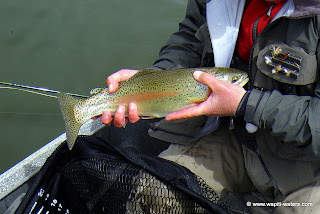
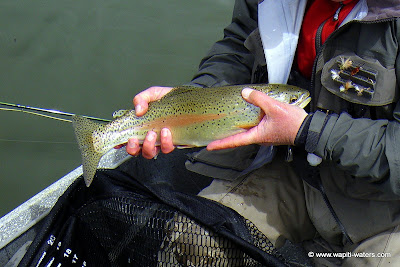
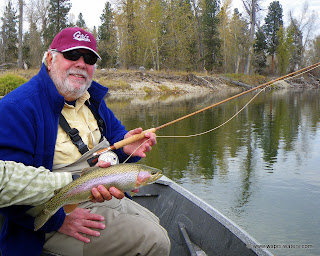
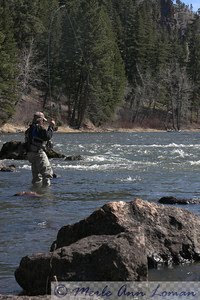
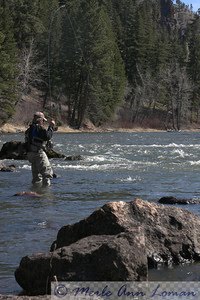
Bitterroot Trout Unlimited (BRTU) is a very active TU Chapter. Many people contribute time, money and goods to help BRTU do its work. Jack always offers a trip for the annual banquet auction and this was the trip for this year. The great thing about this trip is that Greg bid on and got the trip. Greg offers his own time, goods and money for TU, Greg and Jack both serve on the board. It made for a wonderful day. To top it off, Greg invited his friend, Bill to ride along…and everyone caught fish.
The Bitterroot Riverhas fairly good access and early in the season has less ice than the Blackfoot or Clark Fork where it is cooler both in and out of the water. The Bitterroot is the river that western Montana and visiting fishermen and recreators first visit to enjoy the spring.Today was clear. That means cold. It was 36 degrees this morning. It warmed to 40 degrees by 2 p.m. and it was 50 degrees by 5:00 p.m. When the sun is out, that is darn nice weather; but if wind comes or you get wet, it is darn cold weather. Fishermen come prepared with waders, gloves, hats, and layers of warmer jackets. They also bring fishing boats and gear.
The video/automatic slideshow above shows the river and visitation of access sites in the middle river today from Veteran’s Bridge Fishing Access Site (FAS) just north of Hamilton, down-river (north) at two other stops, and finally, about 11 miles north of Hamilton at Tucker Crossing.
Below is the breakdown of vehicles spotted at the times of the photos. What one doesn’t know is, were they wading, putting in or going to take out at the FAS.
Veteran’s Bridge, Hamilton, MT – 12 vehicles, from Idaho and western Montana; 8 had boat trailers; one was a father and kids hanging out.
Woodside Crossing FAS, 5 miles north of Hamilton – 14 vehicles from Idaho and western Montana; 9 had boat trailers.
Private access, 7 miles north of Hamilton – 1 vehicle; a friend from the valley was wade-fishing.
Tucker Crossing FAS, 11 miles north of Hamilton – 26 vehicles, in-state and out-of-state; 16 had boat trailers. One was a hurried shuttle driver moving at least one if not two boat/trailer rigs down-stream.
What does this say? It says spring; it says popular river; it says a lot of recreation use on the river.
Today the river levels are about normal, 307 cubic feet per second (CFS), at the gage station about seventeen highway miles up-stream at Darby in the north end of the valley. But at the gage station near Florence, the river is below normal. Today it is 749 CFS when it is normally above 800 and almost 900 CFS. The water was clear.
Soon a lot of the shelf ice you see in the first photos will melt to become river water; snow in the mountains will also melt and flow in. In a few weeks it will look a lot different. The weather is forecasted to remain cool which will help the snow melt in a slow and orderly fashion. That means the river levels won’t surge as much as they would if the weather were unseasonably warm. We can predict, but, one never knows what the weather, the snow, and the river will actually do. Mother Nature has the power, not us.
Note that the photos show river and bank conditions and debris now, before run-off. When high water comes with the spring run-off, it will change dramatically. The power of the water will take trees, root wads, and anything else it can move down-river and deposit it where ever the debris lodges. When floating after high-water, scout the river carefully and use extreme caution.
Join Missoula and the author for a reading and signing of Anders Halverson’s An Entirely Synthetic Fish. The event will be at Fact & Fiction, 220 N. Higgins Ave, Missoula, Montana on February 10th from 7 pm to 8:20 pm. For more information call the book store at (406) 721-2881. Click here for directions to Fact and Fiction downtown. About the Book
By Anders Halverson
$26.00 – ISBN-13: 9780300140873 Availability: Special Order – Subject to Availability Published: Yale University Press, 3/2010
Anders Halverson provides an in-depth account of the rainbow trout and why it has become the most commonly stocked and controversial freshwater fish in the United States. Rainbow trout have been proudly dubbed “an entirely synthetic fish” by fisheries managers. According to Halverson, his book examines the paradoxes and reveals a range of characters, from nineteenth-century boosters who believed rainbows could be the saviors of democracy to twenty-first-century biologists who now seek to eradicate them from waters around the globe. He discusses how the story of the rainbow trout is the story of our relationship with the natural world—how it has changed and how it startlingly has not.
Anders Halverson is an award winning journalist with a Ph.D. in aquatic ecology from Yale University. With support from the National Science Foundation, he wrote this book as a research associate at the University of Colorado’s Center of the American West.
A lifelong fisherman, he currently lives in Boulder, CO.
For fun, he posted this quiz on GoFishn.com. The winner received his book. The Rainbow Trout Quiz: Question #1 – GoFISHn on GoFISHn In 1996, IdahoDepartment of Fish and Game hatchery managers routinely taught their fish one thing before releasing them into the wild. What was it?
The answer: worms. Candy Craig got it right, and she’s the winner of a copy of the book. The reason the fisheries officials put the fish on a worm diet was to prepare them for the wild. They feared the fish would swim around looking for pellets when they were released, which is their normal fare in the hatchery.
Bob and Peggy live in the Bitterroot south of Hamilton. They love to fish, love the outdoors and are avid Bitterroot Trout Unlimited supporters and members. We are proud of their service to one of our favorite organizations.
They fished with Jack on a nice fall day in late October. Bob used his bamboo rod and both of them caught some nice trout.
Help clean up the Bitterroot River in the Bitterroot Valley of Montana on: Saturday, Sept 11, 2010
10:00 AM to 4:00 PM
Participants and sponsors will be working in the area from Sula, Montana and Painted Rocks Dam at the south end of the Bitterroot Valley all the way north to Missoula, Montana where the Bitterroot River meets the Clark Fork River. The Bitterroot River flows for over 80 miles and has many public accesses. The more participants helping, the better. Bring your work gloves and be ready to meet and make friends with wonderful people.
End the day at the “Barbecue for Participants” at Angler’s Roost, 4:30 PM