by Merle Ann Loman | Mar 9, 2010 | Clark Fork, Conservation/benefits/organizations, Event
Join Clark Fork Coalition and
Montana Trout Unlimited
for the 3rd Annual ‘Guiding Without the Dam’
FWP biologists will describe the state of the fishery at the 2nd anniversary of the removal of Milltown Dam, with special focus on the upper Clark Fork and Flint-Rock drainages, as well as the Clark Fork-Blackfoot confluence.
- WHEN: Wed. March 10, 5:30 – 7:30 PM
- WHERE: CFC office, 140 S 4th W.
- FOOD/BEV: Pizza and Beer
RSVP to info@clarkfork.org – Call 542.0539 with questions

140 S 4th Street West
Missoula, MT 59801-2703
(406) 542-0539
Get directions
In the meantime, help improve the fishery by weighing in on bull trout habitat today! As Montana’s largest native trout and our primary indicator of watershed health, it’s important to safeguard the rivers, lakes, and streams that bull trout call home. Help us make sure the USFWS proposed critical habitat for bull trout is clean, cool, and connected.
SUBMIT COMMENTS today, and ask to include critical habitat for bull trout in the upper river.
by Merle Ann Loman | Feb 16, 2010 | Big Hole, Bitterroot, Blackfoot, Clark Fork, Conservation/benefits/organizations, Missouri
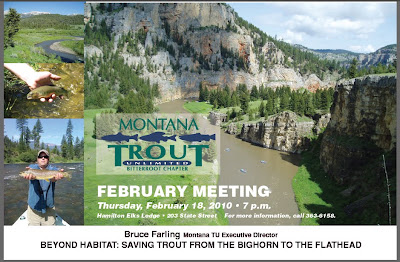
The Feb 18 BRTU meeting will feature Montana TU Executive Director Bruce Farling. Bruce will be giving a slide presentaion on the subject of:
BEYOND HABITAT: Saving trout from the Bighorn to the Flathead in Montana.
The meeting begins at 7:00 PM at the Hamilton Elks Lodge, 203 State Street, Hamilton and is open to the public.
Contact BRTU President Bill Bean for additional information call Bitterroot Trout Unlimited President, Bill Bean at (406) 363-6158, or email Bill at fishaus@blackfoot.net
Please feel free to post or forward to anyone you think might be interested.

203 State Street
Hamilton, MT 59840-2522
(406) 363-3031

by Merle Ann Loman | Feb 10, 2010 | Big Hole, Bitterroot, Blackfoot, Clark Fork, i Spring, ii Summer, iii Fall, Missouri, Other, River
Wapiti Waters’ 2010 fishing season forecast based on over 30 years experience in western Montana’s trout fisheries.
Jack Mauer, Wapiti Waters outfitter and guide
I have just read they will be shipping snow by truck to the site of the 2010 Olympic Games – Cyprus Mountain. Mother Nature has not cooperated but they have had time to prepare for the lack of snow. Likewise, here in the fishing business where a trout fishery depends a lot on good, cold stream flows, we have time to prepare or plan for what looks to be a lean water year.
I hate drought, everybody and everything suffers during times of water stress. Unfortunately conditions are looking more and more like drought as snowpack in the Bitterroot is around 54% of normal at the time of this writing. We have had three months of below average snow precipitation and we have less than two months of winter to go. So the prognosis is not good. What this actually means for the fishing, however, is not all gloom and doom.
Here are my predictions for the 2010 season.
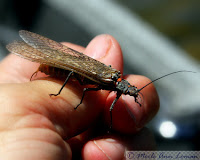
Insect hatch on the Bitterroot in the spring.
Photo by Merle Ann Loman
March and April – Early Spring fishing
Expect fishable water through-out this time. Because our low elevation snow is meager, we should have better than average fishing with more fishable days. It is the melting low elevation snow that causes the rivers to pulse up too quickly with warm weather and/or rain. So I predict excellent early spring fishing in western Montana and that means Skwala and nemoura stones as well as Ameletus and Rithrogenia mayflies.
May and June – Usual period of high-water conditions
Again, I expect better than average fishing for these two months. Many hatches such as the salmonfly; pteronarcella, larger stoneflies; March Brown; and Hydropsyche caddis will come off in good numbers during this time and have the trout looking up on a more consistent basis. Pulsing high waters in the average snowpack year don’t give the trout a chance to key on these hatches before water levels may become too big. This year under the possible lower than average flows, it is likely that trout will get a chance to really key in on them. As a result, these conditions may bring some remarkable fishing.
No matter how big or small the snowpack there will be a time of peak run-off for a 2-3 week period. When this happens, most area rivers will probably be unfishable because of high, turbid water. Here is where flexibility becomes important. Some rivers will likely be fishable and changing the location/river will allow you to take advantage of good conditions. Wapiti Waters has the knowledge and permits that can put you on the right water.

David with a Bitterroot brown trout
Wapiti Waters photo
July and August – Summer fishing
Early July is usually a time of some of the most consistent fishing. I expect that to be the case given the number and variety of aquatic insects that emerge during this time. However, by mid-July the prognosis is not good. Using a preferred strategy for low, warm water conditions in mid-summer, we will need to fish from early morning to early afternoon. Fishing early is in favor the trout and yourself – beating the heat. It is quite possible that rivers like the Blackfoot and the Big Hole will have some angling restrictions during this time.
September and October – Fall Fishing
It is a little too early to predict eight months in advance. Our fall fishing is usually a fly fishers dream here in western Montana. Low flows in the summer are not the single deciding factor of unfavorable fall fishing conditions. For example, last year we had a huge snowpack but we had very tough fall fishing because of unseasonably warm temperatures and bright, sunny weather.
In the mean time, I hope the weather systems in the Pacific will deliver us some welcome precipitation through-out the year.
- Fishing and river articles and photos by Merle Ann Loman by key word:
Bitterroot River | Big Hole River | Blackfoot River | Clark Fork River | Missouri River | Argentina
by Merle Ann Loman | Jan 21, 2010 | Bitterroot, Conservation/benefits/organizations, iiii Winter/Snow, News bulletins
The January BRTU meeting will be at 7:00 PM Thursday, January 21 at the Hamilton Elks Lodge, 203 State Street. Travis Horton, who is the Native Fish Coordinator for Montana Fish, Wildlife and Parks, will give a presentation about Montana’s Native Trout programs. This will be a great opportunity to learn about what makes Montana’s fisheries so special. Attached is the postcard that is being mailed out. Please feel free to forward on to interested friends. If you have any questions, please contact Bill Bean at 363-6158, Fishaus@blackfoot.net
Link to programs offered by Bitterrroot TU
maps.google.com
203 State Street
Hamilton, MT 59840-2522
(406) 363-3031
Get directions

by Merle Ann Loman | Dec 26, 2009 | Big Hole, Bitterroot, Blackfoot, Clark Fork, Friends, iiii Winter/Snow, Missouri
Seasons Greeting from Wapiti Waters in Montana’s Big Sky Country
As we reflect on this past year, we appreciate the gain from our toils and rejoice in the memories of families and angling friends.
Another season has come and gone for Wapiti Waters. Hopefully this winter, we will be partaking in our usual cold month recreational endeavors. Unfortunately the snow hasn’t hit this part of Montana yet. After a reasonably successful hunting season, Merle and I are still hiking around the hills for exercise and “light therapy” rather than skiing. Our immediate focus is keeping the house warm, and sharing our reflections, thanks and hopes with you in this letter. Read on for a recap of our most successful guide season ever.
The 2009 guide season kicked off in mid-March with mild weather, good dry fly fishing and some happy anglers. By the end of March we had icy guides in our rods as an arctic blast descended. Unbelievable as it may seem the Skwalla dry fly fishing was pretty good despite temperatures hovering near 32 degrees. The native cutthroats are incredibly hardy fish. Grilled “brats” and hot soup was the mainstay for lunch.
The rest of spring was fair fishing with flows a little too high at times. 2009 had a huge snow pack and the threat of flooding was imminent.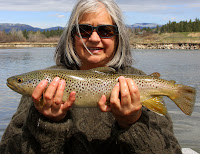 After one big surge in late May, an orderly run off ensued; this prevented a natural disaster. By June 9th we were fishing the Big Hole and Bitterroot forks. From then on Wapiti Waters was busy throughout the summer and into fall. With Merle on bookkeeping, lunches, website and emails, I could focus on my outfitting and guiding. Without the weekly and late Tuesday nights at the Top Hat, I was still able to play parties and weddings with the band and enjoy my music through the guide season.
Highlights from 2009:
Clark Fork is coming back quickly from the Milltown project. Insect hatches that have been suppressed in previous years are showing up again which has stimulated nice angling in certain sections.
The Big Hole had exceptional flows and terrific fishing throughout the season. What a joy to be on this river in August floating and wading in some of the finest trout water in North America.
A hot, sunny September to remember made for some very technical angling. After a predictably good morning trico spinner fall we would take a little time to do some invasive species management. We searched and found northern pike lairs and were modestly successful at pulling some out. What a thrill to see them pursue the fly, strike it and playing that size of a fish. It is a nice change of pace and 180 degrees from trico fishing. For the Pike, we used a 9 weight fly rod and a 2 “aught” air resistant streamer instead of the 4 and 5 weights with a size 20 dry. Now that is variety.
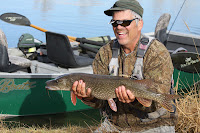
Another arctic freeze-out in early October disrupted an unusually good month of fishing. Fall colors were a gloomy grey green. It was still beautiful to be out but we felt we got cheated without the vibrant yellow and oranges that our stream corridors normally exhibit. We know we can’t always have it the way we want it and we especially appreciated the nice BWO and mahogany dun hatches.
First, we want to thank those who fished with Wapiti Waters in 2009 and wish you all Happy Holiday and a prosperous New Year in 2010 and second (and as important) all the great guides who worked with us.