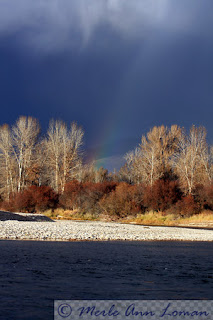
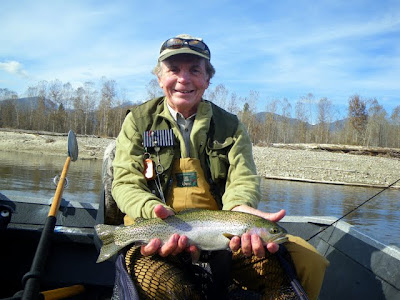
Rainbow on the Bitterroot River
(Photo by Merle Ann Loman)
Fly fishing the Bitterroot River in the fall is fantastic. The weather changes dramatically during the day giving stellar lightshows and the fall hatches mean you will probably see fish noses and fins in select places. As the trout work the hatch, It is definitely a challenge to have targets to throw to. The fun part is trying to pick out which rise form is the biggest trout. By this time of year the trout have seen just about everything but a good presentation. In other words they are very educated but still feeding consistently. The flat smooth water where you find them feeding makes it even more difficult to execute a convincing presentation and drift. Proper selection of dry-flies and tippet are essential.
Give yourself plenty of time to concentrate on certain areas. On the Bitterroot River, there are many pods of feeding fish giving the amateur angler lots of chances to work on technique. If you put the fish down with bad casts, just row back up and wait. Chances are, they will begin feeding in a similar place again. If you don’t want to row up-river, keep going to the next pod. You can see them feeding as you float down the river. Very cool.
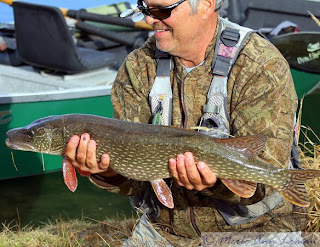
Jack Mauer with a Northern Pike (Photo by Merle Ann Loman)
Want a change of pace? Bring along a 9 weight rod and a box of colorful streamers. As you fish for trout and you come upon a backwater of slow water with significant drop-off next to it, you might consider changing your arsenal to a heavier rod and a very large bright streamer. You have just come into northern pike habitat and they are a HEAVY fish. If you throw the streamer at the drop-off, let it sink and then retrieve it in frequent jerking motions, you will likely tick-off a pike. When a pike hits the fly, you have a fight on your hands. Pike are non-native and predatory so catching them and getting them out of the river is a good thing. The pike in the photo to the right had a whole fish in its stomach. See the slideshow for pictures of the fish. It isn’t pretty.
This pike was about 33 inches long and a tremendous fighter. As Jack caught it, another boat approached from behind. You could hear them cheering Jack on as he worked at bringing the fish into the boat. He thought about getting to shore and landing it there, but it was netted from the boat, barely fitting the net.
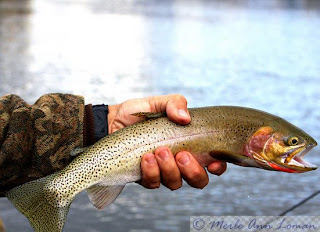
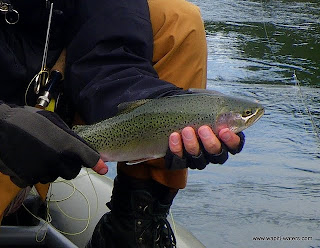
Cutthroat trout (Photo by Merle Ann Loman)
This particular day was about 50 degrees with a slight breeze and overcast. The sun and clouds created unbelievable light shows. Even though this autumn hasn’t produced as many colors and hues as usual, the rainbows and even the gray cast of the aspen have been beautiful. Besides amazing scenery, birds provided entertainment. While looking down the river at pods of fish feeding, beyond and on the curve was an Osprey looking for its dinner. It flew in a tighter circle, dove straight down and made a huge splash. As it came out of the water, there was a sparkle as the sun hit the fish in its talons – probably a whitefish. A few minutes later an eagle soared down the river, passed over the boat and continued downstream. Near the take-out, a Belted Kingfisher played the bank. They are a funny looking bird with a shaggy crest or topknot.
Peter and Chris fished two day with Jack on two different rivers. They really lucked out with the weather. It has been cold, but this Saturday and Sunday, the weather warmed and we and the fish were grateful.
The first photo is Chris on the Bitterroot River.
To the right is a close-up of one of Peter’s Trout.
The last photo is Peter on the Clark Fork River.
Hopefully, Peter and Chris will send us some of the photos they took, maybe even a short video. Thanks for fishing with us!
After a cold spell, there was this very nice day in October. Richard and Jack fished the middle to lower Bitterroot and the fish were very cooperative. The water is very clear and flat. This means the fishing was technical because your fly presentation and drift must be convincing, no drag in the line.
See the slide show to see some of the fish they caught.
It is fall in Montana and great fishing, but watch out for redds. Brown trout are spawning.
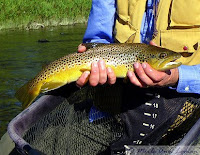
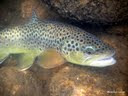
Brown trout from the Bitterroot in the spring
Fall brings cooler temperatures that cue brilliant foliage, migrating geese and spawning brown trout.
Brown Trout (Salmo trutta) is an exotic species in Montana. It was introduced to North America and Montana in the late 1800’s. Brown trout belong to a different genus than our native trout species. Widely stocked early in this century, they are currently doing well as a self-sustaining population.
The brown trout are golden brown with spots, lots of spots. They have black spots that may be irregular, and often red and orange spots. A distinct characteristic is spots with halos on the gill covers. Their tails are short and square. They commonly grow to 12 to 20 inches, but Montana’s state record is 29 pounds.
Brown trout feed largely on underwater aquatic insects. And, as a predaceous fish, more so than rainbow or cutthroat, the larger browns often feed at night on other fish, crayfish and other invertebrates. Brown trout have a few advantages over native Montana trout species. Brown trout are better adapted to disturbed habitats, and can live in areas that experience unnatural changes in water level, temperature, and water quality.
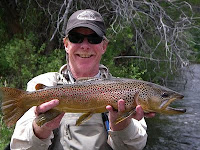
Brown trout caught by Jeff
Brown trout also lay their eggs in the fall, getting a jump on the native species which spawn in the spring making them subject to irrigation seasons water fluctuations among other things. Spawning occurs for brown trout when water temperatures drop to about 40 degrees F. and lasts usually from October through December in Montana. Female brown trout make redds in gravel or small pebbles in shallow water, usually less than a foot deep. Females deposit the eggs, males fertilize the eggs and they are covered with very small gravel or silt. In the spring, about 50 days later and at 50 degrees F, the surviving eggs hatch.
Some brown trout spawn on their resident rivers, but to find the right (very specific) conditions most migrate, sometimes traveling great distances upriver or into tributaries. During this critical time for brown trout, if you are aware of spawning beds where you are fishing, it is preferable not to disturb them.
Here are some things to think about when fishing during the spawning period:
Stay away from the redds, do not walk in them. In general, they will be in clean gravel and it will look like someone dug a hole in the smaller gravel.
Fish downstream to the probable pods of trout below the redd, not IN the redd. A clue is fish sitting on top of thecleared off gravel in pairs.
If you catch a spawning trout, try not to sap their strength; play them quickly, release them quickly and of course, handle them gently.
Last, target fewer fish. Catch a few, and then move on to another area.
Brown trout are usually in the larger, slower and lower gradient streams often where there are logs and other structure available to hide under. They also do well in reservoirs.
Brown trout are a popular game fish and a challenge to catch because they are selective and wary. When an angler catches them, it is exciting as they can be large and put up a good fight, running with the line.
Billy Burk is a friend from Colorado. He is a busy guy with family, work and of course his outdoor recreation. He has been building a “trophy room” and I asked for photos. It isn’t quite “decorated” yet, more photos and mounts to hang. Nice!
When he included these photos of trout he photographed in the Arkansas River, I had to blog them.