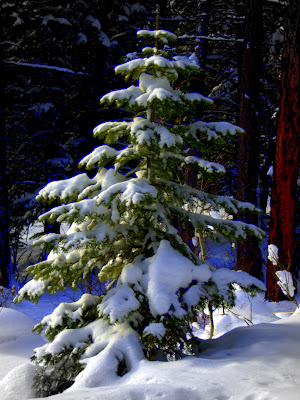
My kind of Christmas Tree

Merry Christmas to all!
May everyone be as happy as Bela when she is rolling in new fallen snow.


Merry Christmas to all!
May everyone be as happy as Bela when she is rolling in new fallen snow.
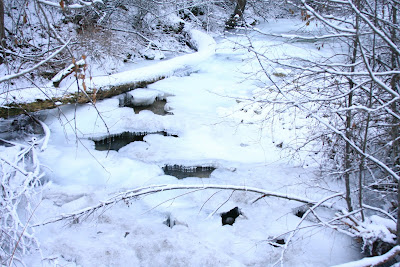

This is my attempt to provide a little more information about trout behavior (Part I); and ice development and anchor ice (Part II). In my research, I found only few studies, and I am pleased to reference for Part I a study that was done here in the Bitterroot.
I ran this article by Chris Clancy, our local Montana Fish, Wildlife and Parks fisheries biologist and one of the authors of the Bitterroot study. His input:
I think the take home message is that some sort of overhead cover and a variety of habitats are helpful to trout in the winter. Streams that are simplified by overgrazing or channelization lose the diversity of habitats. Deep pools are particularly important. I expect the winter movement is not really something they want to do but more likely they have to as the location they are in has changed or somehow become inadequate for their needs, so they find another. Generally in a healthy stream, the mortality during winter is much higher than summer.
Part I – Trout
Trout obviously prefer to expend as little energy as possible in the winter. In the study referenced in this section, bull trout and cutthroat trout made extensive downstream overwintering movements with declining temperature in the fall, yet for the remainder of the study (until late February), most fish remained stationary. Some fish made additional downstream movements in winter during a low-temperature period marked by anchor ice formation. Winter movement was more extensive in the mid elevation stream where frequent freezing and thawing led to variable surface ice cover and frequent supercooling. Habitat use of both species varied with availability; beaver ponds and pools with large woody debris were preferred in one stream, and pools with boulders were preferred in the other. Trout overwintered in beaver ponds in large, mixed aggregations. Both species decreased use of submerged cover following the formation of surface ice.
Their results indicate that (1) continued activity by trout during winter is common in streams with dynamic ice conditions and (2) complex mixes of habitat are needed to provide suitable fall and winter habitat for these species.
My note: It is my understanding the “complex mixes of habitat” produce more static ice conditions and are most often streams with natural vegetation and “undisturbed” i.e. not altered by man (mostly construction) or overgrazing. Open streams, where there is little or no cover and vegetation, produce more dynamic ice conditions. Other studies suggest that even though trout may be in streams with dynamic ice conditions, their preference is for more static or stable conditions – where thermal cover might help keep the surface ice from freezing and thawing.
References for Part I
THE ROLE OF STREAM ICE ON FALL AND WINTER MOVEMENTS AND HABITAT USE BY BULL TROUT AND CUTTHROAT TROUT IN MONTANA HEADWATER STREAMS, Jacober, M. J., McMahon, T. E., Thurow, R. F., Clancy, C. G., Abstract, Page 1 Click here for their paper published by the American Fisheries Society 1998
Part II – Ice
Traditionally, habitat variables have been related to stream flow distribution, structure, cover, temperature, and water quality. Winter and ice formation will influence these variables.
As winter approaches and temperatures lower, the water cools. As it reaches the freezing point, border ice begins to form along the river margins and around obstacles and skim or surface ice forms in low flow velocity areas.
In low gradient areas static ice formation occurs and surface ice is established. Due to increased resistance by the ice, water depth increases and velocities are reduced. In low gradient rivers and river reaches static ice formation occurs enabling stable conditions. Surface ice decreases the amount of light and creates cover against predation and severe hydraulic conditions allowing fish in these areas to preserve energy more efficiently.
Ice production in small, steep rivers is dominated by dynamic ice formation with potential melting and freezing throughout the entire winter. In high gradient sections, such as rapids and riffles, dynamic ice formation dominates. Dynamic ice formation starts when water temperature drops below zero degrees. Here, the water temperature becomes super cooled and tiny ice crystals form, known as frazil ice, or floating ice plates (ice that forms as small plates drifting in rapidly flowing water where it is too turbulent for pack ice to form). In locations with sufficient turbulence, frazil ice is transported towards the riverbed where it adheres and forms anchor ice. Normally, anchor ice formation develops during night and pauses during day.
Anchor ice formation can be extensive and may cover large areas. It may be distinguished between two types according to its formation process: Type I: less dense and forming on top of the substrata and Type II: Dense and forming between the substrata, filling all the small openings and spaces. During the events of anchor ice formation, flow conditions may be substantially altered. Type II anchor ice will potentially exclude important fish habitat. Fish may experience entrapment or be forced to relocate into other suitable areas, preferably surface ice covered stream margins.
In small, steep rivers, extensive growth of anchor ice may occur and lead to the formation of anchor ice dams. These anchor ice dams are normally developed in transition zones between riffle and pool sections and in locations with emergent, large boulders, and can slow further surface ice growth. High mortality of trout has been observed during the formation and breakup of anchor ice dams due to stranding, ice collapse, and physical abrasion from suspended ice particles.
References for Part II
ANCHOR ICE FORMATION AND HABITAT CHOICE OF ATLANTIC SALMON (SALMO SALAR L.)PARR IN STEEP STREAMS, Stickler, M. (M.Sc.), submitted to the Norwegian University of Science and Technology – Click here for the online paper
ICE IN THE ENVIRONMENT, Stickler, M., click here for the online paper


 for our first cross country ski this afternoon. It has been snowing for 24 hours and now that our office work is done for the day, we are heading out for that much anticipated ski!
Skiing was great! Temp was about 12 degrees C. and no wind. See the slideshow below.


How to Shit in the Woods:
An Environmentally Sound
Approach to a Lost Art
“This is the most important environ-
mental book of the decade [1989].”
—W. David Laird, Books of the Southwest
“Kathleen Meyer has contributed to environmental awareness while lending a grand old English word the respectability that it hasn’t had since Chaucer’s day.”
—Frank Graham, Jr., Audubon magazine
“Hey, this is the real shit.”
—Galen Rowell, outdoor photographer and writer
“It’s something we all feel qualified to do, yet never talk about . . . For once, we get good tips on how to keep campsites clean while maintaining modesty and comfort.”
—Outside magazine
Visit www.kathleeninthewoods.com for more about the author and her books.
Kathleen Meyer and Patrick McCarron live in Victor, Montana. Kathleen is an author and has an editing business. Visit her site to find out more. If you need an editor, you will want to consider Kathleen.


Michael McCoy talks about the Calf-A in his travel guide, Montana – Off the Beaten Path – A Guide to Unique Places. He says,”The old building it is housed in was a school from 1903 until 1963, with an average enrollment of twenty kids, and then opened as a restaurant in 1978. Its walls, shelves, and bare pine floor are blanketed with memorabilia, fur-bearing trout, piles of old Life magazines, vintage rifles, an old piano with yellowed sheet music, rocks and fossils, a bedpan banjo, well-worn school desks, pull-down maps, spurs, kerosene lanterns, a ceramic water cooler, and a whole lot more.”
The Calf-A is also called Yesterday’s Cafe or Yesterday’s Calf-A. Click here
for the Travel Montana website and more information.
