by Merle Ann Loman | Jul 29, 2009 | Big Hole, Bitterroot, Blackfoot, ii Summer
Last week we had temperatures in the upper 90 degree range. For us, that is very hot. The water levels were dropping dramatically and the water temperatures were rising on all rivers but the Big Hole and the Blackfoot water temperatures were in the upper 60 and lower 70 degree range. Low water flows and high temperatures stress trout, making them especially vulnerable to disease and predators.
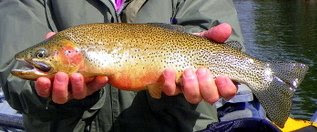
In conditions like these, Wapiti Waters’ goal is to get out early and get off before the water temperatures peak in the late afternoon. We also choose reaches that have cooler/higher water. It is better fishing, easier on the trout and more pleasant for the anglers. Our guides are knowledgeable and skilled at using the tips listed below.
Last night we had a good rain. The short range forecast is for a bit cooler temperatures and we are already seeing water temperatures drop. But, we are heading into August and it will probably heat up again. It is worthwhile to understand how to fish responsibly during hot weather.
Drought Tips by Montana, Fish, Wildlife and Parks
Fish will feel the stress caused by low flows, higher water temperatures and competition for space and food. Low water conditions in spring and fall can cause spawning failures and increased predation on young fish. Also, fish will “group up” to take advantage of pools where the water is deeper and cooler — making them more vulnerable to anglers and predators. If conditions worsen, fish are lost to stress from the higher water temperature, lower oxygen levels, and reduced resistance to disease. These threats can impact adult trout numbers in future years.
To help preserve a threatened fishery anglers can:
- Fish in the cool morning hours — low water flow and rising temperatures combine to stress fish.
- Try another location, if water is low at a favorite fishing spot.
- Be alert for fishing closures on streams hardest hit by drought.
- Work with water users to try to conserve flow.
- Report fish kills to the local Fish, Wildlife & Parks office.
Anglers who practice catch-and-release fishing can minimize the stress they place on fish:
- Use barbless hooks.
- Land fish quickly once they are hooked.
- Keep fish in the water as much as possible while handling them.
- Limit the amount of time fish are handled.
- Wet hands before attempting to remove the hook.
- Handle fish gently.
- Take care not to touch a fish’s gills.
On streams experiencing extreme drought conditions and high water temperatures anglers may want to avoid catch and release fishing as it is difficult for trout to recover under these conditions.
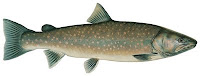
Bull Trout, Arctic Grayling, West Slope Cutthroat Trout are species of concern in Montana.
More information on…
Bull Trout and management during hot/dry conditions: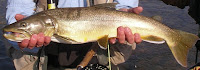
Bull Trout ID site on MT FWP
Under FWP’s drought plan, angling restrictions are called for on streams that provide habitat for bull trout when stream flows reach 1-in- 20-year lows and maximum daily water temperatures equal or exceed 60 degrees for three consecutive days. For all other trout, the water temperature to trigger angling closures is 73 degrees for three consecutive days.
Arctic Grayling on the Big Hole and management during hot/dry conditions: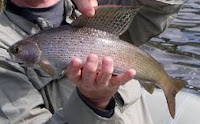
The Big Hole River Watershed Committee identifies when low river flows should trigger angling closures.
These trigger points were met in early August of 2006, placing the river’s grayling at risk. The upper and middle reaches of the Big Hole totaling 47 miles were closed due to low water flows and high water temperatures.
The upper reach of the river was not opened until it exceeded 40 cfs for at least seven consecutive days with water temperatures that did not exceed 70 degrees for more than eight hours a day for three consecutive days.
The middle reach reopened when the river exceeded 80 cfs for at least seven consecutive days with the same water temperature guidelines.
To read more, click this link for Big Hole River Drought Management Plan
Note: 21 °C = 70 °F, 16 °C = 61 °F
Click here for Wapiti Waters Stream Flow Links
by Merle Ann Loman | Dec 23, 2008 | Conservation/benefits/organizations, iiii Winter/Snow
Click the photo for a larger view in a new window.
This is my attempt to provide a little more information about trout behavior (Part I); and ice development and anchor ice (Part II). In my research, I found only few studies, and I am pleased to reference for Part I a study that was done here in the Bitterroot.
I ran this article by Chris Clancy, our local Montana Fish, Wildlife and Parks fisheries biologist and one of the authors of the Bitterroot study. His input:
I think the take home message is that some sort of overhead cover and a variety of habitats are helpful to trout in the winter. Streams that are simplified by overgrazing or channelization lose the diversity of habitats. Deep pools are particularly important. I expect the winter movement is not really something they want to do but more likely they have to as the location they are in has changed or somehow become inadequate for their needs, so they find another. Generally in a healthy stream, the mortality during winter is much higher than summer.
Part I – Trout
Trout obviously prefer to expend as little energy as possible in the winter. In the study referenced in this section, bull trout and cutthroat trout made extensive downstream overwintering movements with declining temperature in the fall, yet for the remainder of the study (until late February), most fish remained stationary. Some fish made additional downstream movements in winter during a low-temperature period marked by anchor ice formation. Winter movement was more extensive in the mid elevation stream where frequent freezing and thawing led to variable surface ice cover and frequent supercooling. Habitat use of both species varied with availability; beaver ponds and pools with large woody debris were preferred in one stream, and pools with boulders were preferred in the other. Trout overwintered in beaver ponds in large, mixed aggregations. Both species decreased use of submerged cover following the formation of surface ice.
Their results indicate that (1) continued activity by trout during winter is common in streams with dynamic ice conditions and (2) complex mixes of habitat are needed to provide suitable fall and winter habitat for these species.
My note: It is my understanding the “complex mixes of habitat” produce more static ice conditions and are most often streams with natural vegetation and “undisturbed” i.e. not altered by man (mostly construction) or overgrazing. Open streams, where there is little or no cover and vegetation, produce more dynamic ice conditions. Other studies suggest that even though trout may be in streams with dynamic ice conditions, their preference is for more static or stable conditions – where thermal cover might help keep the surface ice from freezing and thawing.
References for Part I
THE ROLE OF STREAM ICE ON FALL AND WINTER MOVEMENTS AND HABITAT USE BY BULL TROUT AND CUTTHROAT TROUT IN MONTANA HEADWATER STREAMS, Jacober, M. J., McMahon, T. E., Thurow, R. F., Clancy, C. G., Abstract, Page 1 Click here for their paper published by the American Fisheries Society 1998
Part II – Ice
Traditionally, habitat variables have been related to stream flow distribution, structure, cover, temperature, and water quality. Winter and ice formation will influence these variables.
As winter approaches and temperatures lower, the water cools. As it reaches the freezing point, border ice begins to form along the river margins and around obstacles and skim or surface ice forms in low flow velocity areas.
In low gradient areas static ice formation occurs and surface ice is established. Due to increased resistance by the ice, water depth increases and velocities are reduced. In low gradient rivers and river reaches static ice formation occurs enabling stable conditions. Surface ice decreases the amount of light and creates cover against predation and severe hydraulic conditions allowing fish in these areas to preserve energy more efficiently.
Ice production in small, steep rivers is dominated by dynamic ice formation with potential melting and freezing throughout the entire winter. In high gradient sections, such as rapids and riffles, dynamic ice formation dominates. Dynamic ice formation starts when water temperature drops below zero degrees. Here, the water temperature becomes super cooled and tiny ice crystals form, known as frazil ice, or floating ice plates (ice that forms as small plates drifting in rapidly flowing water where it is too turbulent for pack ice to form). In locations with sufficient turbulence, frazil ice is transported towards the riverbed where it adheres and forms anchor ice. Normally, anchor ice formation develops during night and pauses during day.
Anchor ice formation can be extensive and may cover large areas. It may be distinguished between two types according to its formation process: Type I: less dense and forming on top of the substrata and Type II: Dense and forming between the substrata, filling all the small openings and spaces. During the events of anchor ice formation, flow conditions may be substantially altered. Type II anchor ice will potentially exclude important fish habitat. Fish may experience entrapment or be forced to relocate into other suitable areas, preferably surface ice covered stream margins.
In small, steep rivers, extensive growth of anchor ice may occur and lead to the formation of anchor ice dams. These anchor ice dams are normally developed in transition zones between riffle and pool sections and in locations with emergent, large boulders, and can slow further surface ice growth. High mortality of trout has been observed during the formation and breakup of anchor ice dams due to stranding, ice collapse, and physical abrasion from suspended ice particles.
References for Part II
ANCHOR ICE FORMATION AND HABITAT CHOICE OF ATLANTIC SALMON (SALMO SALAR L.)PARR IN STEEP STREAMS, Stickler, M. (M.Sc.), submitted to the Norwegian University of Science and Technology – Click here for the online paper
ICE IN THE ENVIRONMENT, Stickler, M., click here for the online paper

by Merle Ann Loman | Dec 18, 2008 | Bitterroot, iiii Winter/Snow
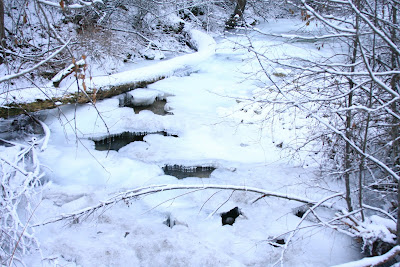
Bear Creek is on the west side of the Bitteroot Valley near Victor. This week temperatures were about zero during the day and minus 16 during the night. We have plenty of water from the previous rains and now it is turning to ice. It is beautiful, but where are all the fish to go?
Click here to read a paper titled Role of Stream Ice on Fall and Winter Movements and Habitat Use by Bull Trout and Cutthroat Trout in Montana Headwater Streams.
An excerpt from the Conclusion: Complex mixes of habitat are needed to maintain suitable fall and winter habitat for stream resident bull trout and westslope cutthroat trout populations. Beaver ponds, deep pools, and submerged cover of large woody debris (LWD), boulders, and undercut banks are important components of this mix. Bull trout appear particularly susceptible to loss of habitat complexity. In the Bitterroot River drainage, bull trout are rare in watersheds with a high degree of disturbance (Clancy 1993) and without LWD or pools (Rich 1996). Shallow, wide streams not only lack suitable winter cover, but also promote subsurface ice formation (Chisholm et al. 1987; Brown et al. 1994). In degraded areas, activities that moderate fluctuations in winter stream temperature (i.e., riparian vegetation restoration) and that create deep water habitats (i.e., beaver reintroduction) may help alleviate poor winter habitat conditions.
It is a scientific paper, a dry read, but if you are interested in trout habitat, you will find it very informative, yet there is still much to learn about ice and trout survival.

After I created this post, I remembered a photo I had taken on Sweathouse Creek in November. This is from the property that butts against Forest Service near the trailhead for Sweathouse Creek.
There is a county bridge (actually culverts topped with road gravel) across Sweathouse right here. These people just bought the chunk of land that is on both sides of the creek. They can access all of their land by the county bridge, but they wanted their own bridge. They got permission to build it. In the process, they are reaming out an area of the creek where they will are building a winding road and footings and a bridge.
You are seeing some of the woody debris and plant material that they have removed. I find it horrific that they did this. After reading the paper above, I am more disturbed about it. Just my opinion.
by Merle Ann Loman | Nov 30, 2008 | Conservation/benefits/organizations
Click here for the
Western Native Bull Trout website showing a bull trout location map and an assessment document.
Once again, our friend and New Heathens band member, Nate Schweber in New York (but from Missoula) has impressed me with his social blogging.
An excerpt of Nate’s blog: A Canadian mining company wants to dig up coal at the headwaters of the North Fork of the Flathead River, which forms the western boundary of Glacier National Park. I go fishing there every summer. Boooo! Read on for his “double boo” and “triple boo.” Please visit his blog about Canadian Coal vs Bull Trout.
Click here for a Missoulian newspaper story,
Canada: Mine planned atop habitat for bull trout By MICHAEL JAMISON of the Missoulian.
Nate found the story and has the link on his website (thank you Nate).