The January BRTU meeting will be at 7:00 PM Thursday, January 21 at the Hamilton Elks Lodge, 203 State Street. Travis Horton, who is the Native Fish Coordinator for Montana Fish, Wildlife and Parks, will give a presentation about Montana’s Native Trout programs. This will be a great opportunity to learn about what makes Montana’s fisheries so special. Attached is the postcard that is being mailed out. Please feel free to forward on to interested friends. If you have any questions, please contact Bill Bean at 363-6158, Fishaus@blackfoot.net
Seasons Greeting from Wapiti Waters in Montana’s Big Sky Country
As we reflect on this past year, we appreciate the gain from our toils and rejoice in the memories of families and angling friends.
Another season has come and gone for Wapiti Waters. Hopefully this winter, we will be partaking in our usual cold month recreational endeavors. Unfortunately the snow hasn’t hit this part of Montana yet. After a reasonably successful hunting season, Merle and I are still hiking around the hills for exercise and “light therapy” rather than skiing. Our immediate focus is keeping the house warm, and sharing our reflections, thanks and hopes with you in this letter. Read on for a recap of our most successful guide season ever.
The 2009 guide season kicked off in mid-March with mild weather, good dry fly fishing and some happy anglers. By the end of March we had icy guides in our rods as an arctic blast descended. Unbelievable as it may seem the Skwalla dry fly fishing was pretty good despite temperatures hovering near 32 degrees. The native cutthroats are incredibly hardy fish. Grilled “brats” and hot soup was the mainstay for lunch.
The rest of spring was fair fishing with flows a little too high at times. 2009 had a huge snow pack and the threat of flooding was imminent. After one big surge in late May, an orderly run off ensued; this prevented a natural disaster. By June 9th we were fishing the Big Hole and Bitterroot forks. From then on Wapiti Waters was busy throughout the summer and into fall. With Merle on bookkeeping, lunches, website and emails, I could focus on my outfitting and guiding. Without the weekly and late Tuesday nights at the Top Hat, I was still able to play parties and weddings with the band and enjoy my music through the guide season.
Highlights from 2009:
Clark Fork is coming back quickly from the Milltown project. Insect hatches that have been suppressed in previous years are showing up again which has stimulated nice angling in certain sections.
The Big Hole had exceptional flows and terrific fishing throughout the season. What a joy to be on this river in August floating and wading in some of the finest trout water in North America.
A hot, sunny September to remember made for some very technical angling. After a predictably good morning trico spinner fall we would take a little time to do some invasive species management. We searched and found northern pike lairs and were modestly successful at pulling some out. What a thrill to see them pursue the fly, strike it and playing that size of a fish. It is a nice change of pace and 180 degrees from trico fishing. For the Pike, we used a 9 weight fly rod and a 2 “aught” air resistant streamer instead of the 4 and 5 weights with a size 20 dry. Now that is variety.
Another arctic freeze-out in early October disrupted an unusually good month of fishing. Fall colors were a gloomy grey green. It was still beautiful to be out but we felt we got cheated without the vibrant yellow and oranges that our stream corridors normally exhibit. We know we can’t always have it the way we want it and we especially appreciated the nice BWO and mahogany dun hatches.
First, we want to thank those who fished with Wapiti Waters in 2009 and wish you all Happy Holiday and a prosperous New Year in 2010 and second (and as important) all the great guides who worked with us.
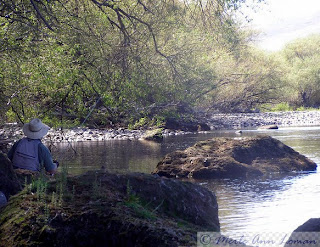
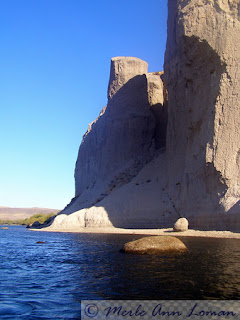
Jack Mauer on Rio Chimehuin (Photo by Merle Ann Loman)
Fly fishing in Montana might be similar to fly fishing in Argentina, but Argentina’s open spaces are even vaster. Jack Mauer first visited the Patagonia region of Argentina in February and March of 2006. He knew that there would be great fly fishing and made the most of it by floating, fly fishing and camping on many different rivers. In 2008, he and his partner, Merle, visited in February and March again. On this trip they spent time in Buenos Aires, San Carlos de Bariloche and San Martín de los Andes. They also fished three rivers, the Chimehuin, Malleo and Collón Curá in the Neuquén District of Argentina. On Jack’s first trip, he fished all these and the Limay, Aluminé and Caleufu rivers.
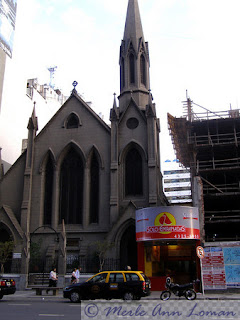
A favorite city to enter the country is the capitol, Buenos Aires. Take the time to explore the city. It is a vibrant and friendly city with outstanding restaurants, shops, museums and architecture. Taxis, buses and walking are great ways to get from district to district.
Church in Buenos Aires (Photo by Merle Ann Loman)
The domestic airport in Buenos Aires is the Jorge Newbery Airport. From there, they flew an Argentinean airline, LAN, to a beautiful town at the base of the Andes called San Carlos de Bariloche. The busy city is on the shores of Lake Nahuel Huapi, which combined with mountains and forests makes a picture book site and offers much for an outdoor enthusiast to do in both summer and winter. Cerro Catedral, one of Argentinas largest ski areas, is just minutes from town. To the north, by way of a beautiful drive through forests and by lakes, are San Martín and Junín de los Andes.
San Martín is on the shores of Lake Lacar. It has a busy bus station. Public buses are a popular way to travel in Argentina. The downtown area and central park are just a few blocks from the lake. The shops are colorful and bustling with activity and goods.
Junín is a bit smaller and is on the banks of the river Chimehuin. It has motels, restaurants, grocery stores and shops surrounding its central park.
Traveling in Argentina is easy and safe as long as you use common sense and keep your valuable belongings with you or safely locked in your lodging. It is useful to visit travel blogs, such as Trip Advisor to see what other people have experienced. The airlines, buses, taxis and rental car companies give you many options for getting around. The infrastructure is modern and well maintained. People in Argentina are very friendly and helpful, many of them speaking English fairly well.
If you want to fish, as in Montana, you need a fishing license. The cost was around $50 at fly shops. Jack recommends using a professional fly fishing guide. Be sure to visit a reputable fly shop for your license and guide. There are rogue guides that are not licensed properly and you do not want to get in trouble with the law by using an unlicensed guide off the street. There are many shops and lodges that hire qualified guides that have a picture ID with proof of license and insurance. The cost of a day fishing float compares to Montana starting at about $400 and going up from there. The best months to fish are November through March.
If you like this article, be the first to see the more, subscribe by email at Merle’s Outdoor Recreation site on Examiner.com. You can also subscribe by RSS, Twitter, or Facebook. More Argentina and fly fishing articles coming soon!
Peter and Chris fished two day with Jack on two different rivers. They really lucked out with the weather. It has been cold, but this Saturday and Sunday, the weather warmed and we and the fish were grateful.
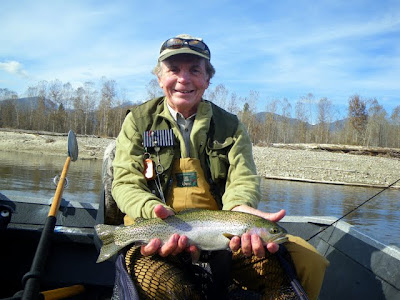
The first photo is Chris on the Bitterroot River.
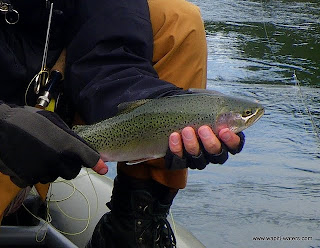
To the right is a close-up of one of Peter’s Trout.
The last photo is Peter on the Clark Fork River.
Hopefully, Peter and Chris will send us some of the photos they took, maybe even a short video. Thanks for fishing with us!
After a cold spell, there was this very nice day in October. Richard and Jack fished the middle to lower Bitterroot and the fish were very cooperative. The water is very clear and flat. This means the fishing was technical because your fly presentation and drift must be convincing, no drag in the line.
See the slide show to see some of the fish they caught.